

The Storyboard Media Group Blog
Not Your Typical PSA: How We Turned Art Into Impactful Video Content
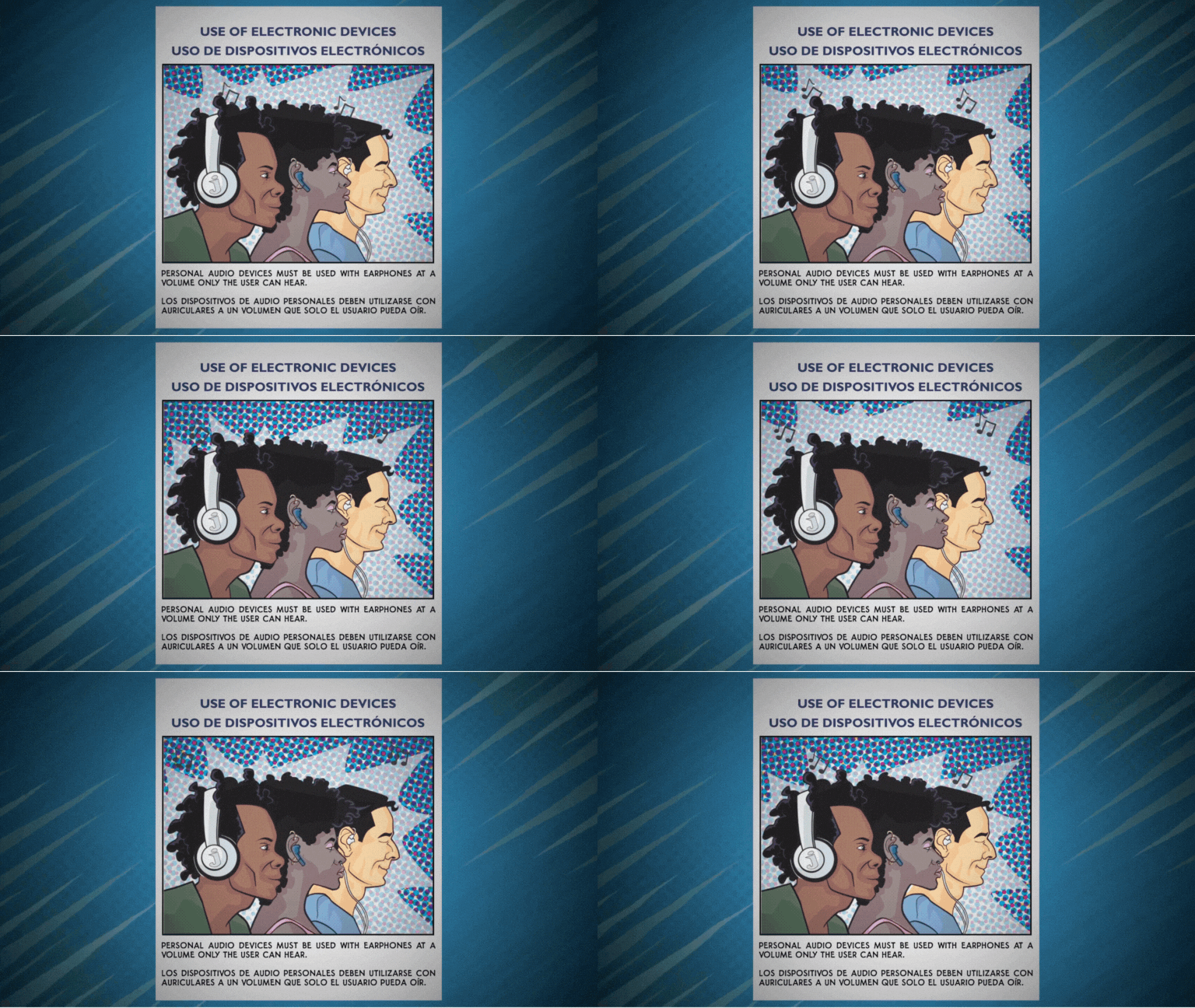
At Storyboard Media Group, we believe the best content is content that stands out — which is why we partnered with artist L Jamal Walton and RATP Dev USA to create a truly unique animated PSA for GoDurham. By transforming static comic-style artwork into dynamic motion, we helped turn a routine public message into something eye-catching and memorable. This behind-the-scenes look shows how thoughtful planning, creative animation, and bold choices can elevate brand messaging across any platform. It’s a great reminder that when it comes to content, different gets noticed.
Something Unique as an Attention-Grabber
Storyboard Media Group recently partnered with artist L Jamal Walton and the team at RATP Dev USA to create an animated Public Service Announcement for the transit organization GoDurham. We (and the client) are really pleased with how this turned out and the role it will play in educating the public that uses the GoDurham system.
We’re sharing it here because we always suggest to clients that they try something a little different whenever possible in order to have content that is uniquely theirs. And we think this video is a great example of how marketers, learning and training professionals, and public organizations can think outside the box to create something that is different - but that still holds value as a communication device. See the video below.
What Are You Looking At?
Animating artwork isn’t an easy process, but it is a process that is made possible by adhering to a plan. Here’s the process step-by-step that went into creating this content:
1. Receiving 10 panels of artwork from the artist - L Jamal delivered 10 panels of comic book style artwork to us in layered files.
2. Examining the layers in the artwork - breaking down each panel and taking a look ‘behind the curtain’ gave us an idea of what we could, and couldn’t do, with the art.
3. Storyboarding the video - We presented the client with a graphical map of how the animation would move including transitions, backgrounds, on-screen text and more.
4. Creating a voice over - We gave the client a total of 9 voice artist options to choose from. In order to do this we asked artists to create two sentence examples of their voices and deliveries by providing them a portion of the script we created. Once the client decided who they liked, we had the voiceover produced.
5. Animating the static artwork - This is where the bulk of the work really began. We needed to separate all the artwork layers, create new layers, redraw some of the artwork (always staying true to the artist’s vision), put all the layers into animation software and create motion work to make things ‘pop’ as much as possible. This was not only the most difficult portion of the project, but also the most time-consuming.
6. Adding music, branding, voiceover - This is the stage where the animation and all the supporting content comes together to make the final video. If the plan is followed, everything should just fall into place. And that’s exactly what happened.
Where Is the Client Using the Content?
Because this is a public education piece, the video is being seen on all types of screens in a bunch of different environments. These include bus stations, on the organization website and social channels, television screens on buses, and other public spaces. For the most part, the audience will be captive (waiting for a bus, sitting on a bus, etc.) and it’s important that this video goes beyond the standard ‘do’s and dont’s’ type content you might expect to see when it comes to public organizations.
This was a fun project to work on and we think it’s a great example of how and why brands can try something a little different in order to stand out.
“Storyboard Media Group was an absolute pleasure to work with. They met our tight deadline and delivered a final video that exceeded our company’s expectations. Even with last-minute changes, their team accommodated us seamlessly and without hesitation.
Their communication was outstanding, and they put us completely at ease, we knew we had chosen the right partner to bring this campaign to life. We highly, highly recommend Storyboard Media Group and look forward to working with them again on future video projects.”
Why My Creative Agency is Choosing Humans Over AI
Storyboard Media Group’s founder explores the impact of AI on the creative industry and the decision to remain human-led. After a year of reflection, this article outlines why the agency will continue to prioritize human collaboration over AI-generated media. Learn about our commitment to supporting creative professionals and why we believe authentic human experience is essential to high-quality storytelling.
Article Highlights
After a year of reflection, Storyboard Media Group is officially committing to a human-first creative process.
While AI can replicate output, it cannot replicate the human connection, shared experiences, and on-set problem solving that define the creative process.
Storyboard Media Group will utilize AI only for minor time-saving tasks that do not displace human roles such as voice actors, animators, or crew members.
Acknowledging that AI-adoption may lower competitor costs, Storyboard Media Group prioritizes long-term creative integrity, human work, and "sweat equity" over short-term profit maximization.
A Year of Analysis Paralysis
Writing this article has been on my to-do list for at least a year. Yet I’ve never sat down at my keyboard to type it out. It’s never been mediocre, run-of-the-mill procrastination that has stopped me from doing it. Instead, I chalk it up to analysis paralysis. It’s been more than a year of rethinking, over-thinking, thinking twice, considering this and considering that, taking this and that into account, thinking of the fallout (if there is any), writing lines and then deleting them ad nauseam.
Still, allow me take a moment to start at the beginning - I founded Storyboard Media Group in March of 2013. Since that time I have worked with amazing clients, on amazing projects, with amazing creatives and partners in amazing places. Storyboard’s clients include startups, Fortune 100s, lifestyle brands, the US Military, schools and universities, tech companies and the list goes on and on. My team and I have filmed product videos, interviews, L&T videos, instructional videos, live events, television commercials, and social media content. We’ve worked in NY, NJ, CT, PA, VA, CA, TX, Ontario, Canada, Ireland, Portugal and a few other places along the way. Our video work that has gone on to help win Brandon Hall awards for our clients, led successful funding campaigns, helped with product launches, taught young people about music and given career advice.
Since the creation of my company I’ve continued to learn (about business and my craft), grow in confidence and abilities, and create and connect with clients, partners, freelancers and other filmmaking professionals.
I don’t say these things to tout the accomplishments of my business. In fact, I mention all this because it’s essential to what I want to - finally - put into words.
The Timeline of Useful AI
I remember about 5 years ago when people were really starting to talk about AI and what it was going to be able to do. They always seemed to put a 10 year countdown on the warnings. I always (and rightfully so) said that it wasn’t going to take that long at all. And that jobs and livelihoods were going to be affected in big ways long before people expected it. Now we’re here, on that precipice with a lot of people already starting to feel the pain: filmmakers, marketers, content producers, service industry workers, doctors, grocery workers, lawyers, blue collar, white collar, etc.
AI creates visuals, spreadsheets, new software, games, code, it can find diseases, it can write stories, and it can look and sound like a human. As it continues to improve it will take more jobs - this job, that job, her job, your job, their job, his job, your mother’s job, your nephew’s job, etc. All the while It is being pushed by people who - in their own words - aren’t exactly sure where it will lead, why it will lead us there, and if it’s even safe and advisable to keep it going.
But this article isn’t about the politics of AI. It isn’t specifically about the positives or negative of AI. And it isn’t meant to focus on the macro-level concerns about the moral, societal, or economical questions about AI. Instead, it’s an answer to something I’ve been asking myself, first as a creator, and second as a member of a functioning society. That question is “how will I personally approach the effects of AI?”
Some Current Impacts
Almost all of us are being affected by AI - even if it’s not a topic of everyday conversation. Some people are losing their jobs as a direct, immediate result from the implementation of AI in the workplace. Those that aren’t currently losing jobs are feeling the effects in a tougher economy, and/or an existential dread knowing that the clock is ticking until they lose their job, or their spouse loses theirs. I feel angry. I feel sad. And I feel terrible for people who are taking the first punches from this paradigm shift.
But I’m also heartened to see people start to demand limits to AI - whether it’s labels on digital content to identify AI, music platforms banning AI music, and some magazines taking a public stance to say no to AI images. And I love the uproar when some businesses use AI in ways that are just completely out-of-touch with life.
A Business Owner’s Response to AI
In my personal (non-business) life I take an approach to AI that includes immediately turning off and clicking out of things made with AI - music, movies, commercials, news segments, photos, stories, and political propaganda. Unfortunately, AI will keep getting better and make it harder to identify and tune out. While I realize that I won’t single-handedly stop the march of AI, I know the alternative to doing these small things is to do nothing. And that’s not a ‘nothing’ I’m prepared to do. Regardless, these personal strategies are not the subject of this article.
How will I approach AI as a creative professional and as a business owner? The answer to this question is the thing I’ve been wanting to write for over a year. Storyboard will continue to hire, and work with humans to do creative work. It’s just that simple for me. And although I’m only one business owner who runs a small business, the alternative to doing this is to use AI in any way possible and disregard all the people who have made their careers in creative work; they’ve honed their skills, they’ve learned to run their businesses, and to market themselves. In essence, they have blood, sweat and tear equity in what they do.
I understand that many other agencies will adopt as much as AI as they possibly can to maximize their profits at the expense of people. They can do that, it’s their choice. And I understand that this will most likely drive costs down for those agencies so they can drop their rates and handily compete against agencies like Storyboard Media Group that continue to utilize human beings to do creative work. This is a race to the bottom as far as I’m concerned, and it’s one I have no interest in pursuing or trying to win.
Why Do I Favor Humans?
Over time, I’ve worked with amazing clients on amazing projects alongside other amazing creative professionals. I’ve solved unexpected challenges with in-the-moment solutions on set. In this work I’ve laughed with others, gotten stressed out and bailed out on location, made mistakes, had victories, listened, directed, talked with my team and clients over lunches, created beautiful scenes on camera, felt the thrill of getting the first shot of a project after days or weeks of planning, and so much more. I’ve woken up at 4am just to beat traffic into NYC so that a 9am start time is possible. I’ve wrapped a project at 5pm and been stuck in a car in traffic with my team in the city until 9pm because of a problem at a tunnel or bridge.
Human connections, human experiences, and human creation - no matter how brief they may be (days, months or years) - are the core of what I believe we are as humans. Left unchecked, AI will take a lot if this away and leave us with…what? So I choose to ‘check’ it however tiny my footprint may be.
Yes, there are AI tools that I think are useful and time-saving. Storyboard will use these when they don’t come at the expense of a freelancer, voice over artist, on-set workers, hair and makeup artists, animators and other positions. Yes I am aware that this may prove to be the existential threat to my company. I sincerely hope not, but in reality this is out of my hands in light of the decision I’ve made.
What Will the Future Hold?
Like everyone else, I have no idea. However, I do see humans starting to push back against the onslaught of AI. For example, new production companies are slowly taking shape to fill in the creative vacuum that is definitely going to be left behind as major movie studios start AI-slopping their product onto streaming platforms and into movie theaters. And in other cases magazine editors have put AI rules into effect that - among other things - help protect jobs.
In other words, I see some humans fighting back by consciously deciding to go around the whole AI sphere and do what humans do best - create, connect, fail, succeed, overcome and experience things for the mere sake of doing those things, and feeling the accomplishment of creating. This is what I’m choosing to do with Storyboard Media Group in my own little corner of the creative sphere and, whatever the outcome, I’m comfortable with my decision.

More Than Just Views: Why Your Next Powerhouse Video Needs to Be Interactive
Sometimes simply creating a video isn't enough. All of us are constantly bombarded with content, and capturing your customer’s attention – and more importantly, holding it – is a constant challenge. But what if your videos could do more than just play? What if they could engage, personalize, and even convert?
Welcome to the world of interactive video, a content format that's changing how businesses connect with their audience.
Sometimes simply creating a video isn't enough. All of us are constantly bombarded with content, and capturing your customer’s attention – and more importantly, holding it – is a constant challenge. But what if your videos could do more than just play? What if they could engage, personalize, and even convert?
Welcome to the world of interactive video, a content format that's changing how businesses connect with their audience.
What Exactly is an Interactive Video?
Interactive videos go above and beyond what we can call ‘passive viewing.’ Interactive videos transform your audience from spectators into active participants. For example, imagine a video where viewers can:
Choose their own adventure: Guide the storyline, leading to content that is most relevant to their interests.
Click on products: Instantly learn more about an item, or even add it to a cart, directly within the video.
Test their knowledge: Answer quiz questions or participate in polls, making their experience dynamic and memorable.
Explore a scene: Dive into a 360-degree view, experiencing your content in an new, immersive way.
Provide their details: Seamlessly fill out a lead form without ever leaving the video.
Being able to make these things happen isn’t just a fancy trick - it’s interactive video. It’s a powerful tool designed to create a personalized, engaging, and highly effective viewing experience.
How Interactive Video Drives Real Results for Your Brand
Do you want to make your content work harder all while making it easier for your audience to get familiar with your brand? Interactive video offers a compelling ROI by:
Skyrocketing Engagement: By giving viewers control, you hold their attention longer. This isn't just about watch time; it's about meaningful interaction that creates a lasting impression. We are fed so much digital information all the time that being able to take a little control of video content, and maybe even having a little fun, seems like a gift.
Boosting Conversions & Sales: Imagine a customer seeing a product they love in your video and being able to click and buy it right then and there. Interactive "shoppable" videos shorten the sales funnel, turning viewers into buyers more efficiently. There’s no more seeing your product and then having to search somewhere else for it.
Personalizing the Customer Journey: No two customers are alike. With branching narratives, you can tailor the video experience to individual preferences, delivering highly relevant content that resonates deeply.
Supercharging Lead Generation: Embed forms and data inputs directly into your videos to capture valuable customer information effortlessly, streamlining your lead nurturing process.
Revolutionizing Training & Education: From onboarding new employees to explaining complex product features, interactive videos make learning more dynamic, engaging, and ultimately, more effective with embedded quizzes and knowledge checks.
Where and How Does Interactive Video Truly Shine?
There are a ton of really effective use case scenarios for this type of content. And while it may not always be the direction you need to take your brand, there are situations where it shines making it an absolute ‘must.’
Marketing & Advertising: You can craft unforgettable ad campaigns, demonstrate products with interactive moments, and tell your brand story in a way that truly captivates.
E-commerce: Transform product showcases into direct sales channels with clickable ‘hotspots’ and integrated purchasing options. This is a great way to make the purchasing decision of your customer easy and quick.
Education & Corporate Training, and Internal Communications: Use it to create incredibly engaging learning modules, interactive tutorials, and effective onboarding experiences that improve knowledge retention for your team. You can also use interactive video to release important company updates and policy explanations, and team building content that is more engaging and impactful for your employees.
The Best Part? No Special Software Needed (for your audience!)
One of the biggest misconceptions about interactive video is that viewers need special software to watch it. Not true! The beauty of interactive video is that your audience can experience it seamlessly in their standard web browser or on their device.
While creating these dynamic experiences does require specialized platforms that allow us to embed these interactive elements, the end result is most often an embed of a highly compatible and accessible video that plays just like any other, but with a powerful difference. Even YouTube provides a way to make your videos interactive with the ‘chapters’ option which makes it easy for viewers to click directly to content they want to watch.
Ready to Transform Your Video Content?
Storyboard Media Group specializes in crafting high-impact video content that delivers exceptional returns. Interactive video isn't just a trend; it's a strategic tool that can elevate your brand, engage your audience like never before, and drive measurable results.
The Secret Ingredient to a Powerful Testimonial Video
Looking to elevate your testimonial videos? It's not about product features alone. The most impactful testimonials hinge on one crucial element: story. Learn why authentic client narratives—showcasing real journeys from challenge to solution—are essential for truly connecting with your audience and driving conversions.
The Secret Ingredient to a Powerful Testimonial Video? It All Boils Down to One Word: Story
Every brand wants to tell a story – their story. While the word "story" might feel overused in the digital marketing landscape, there's a good reason for it - especially when it comes to crafting compelling testimonial videos. We believe it’s the single most crucial element that transforms a good testimonial into a great one.
So, What Exactly Do We Mean by "Story"?
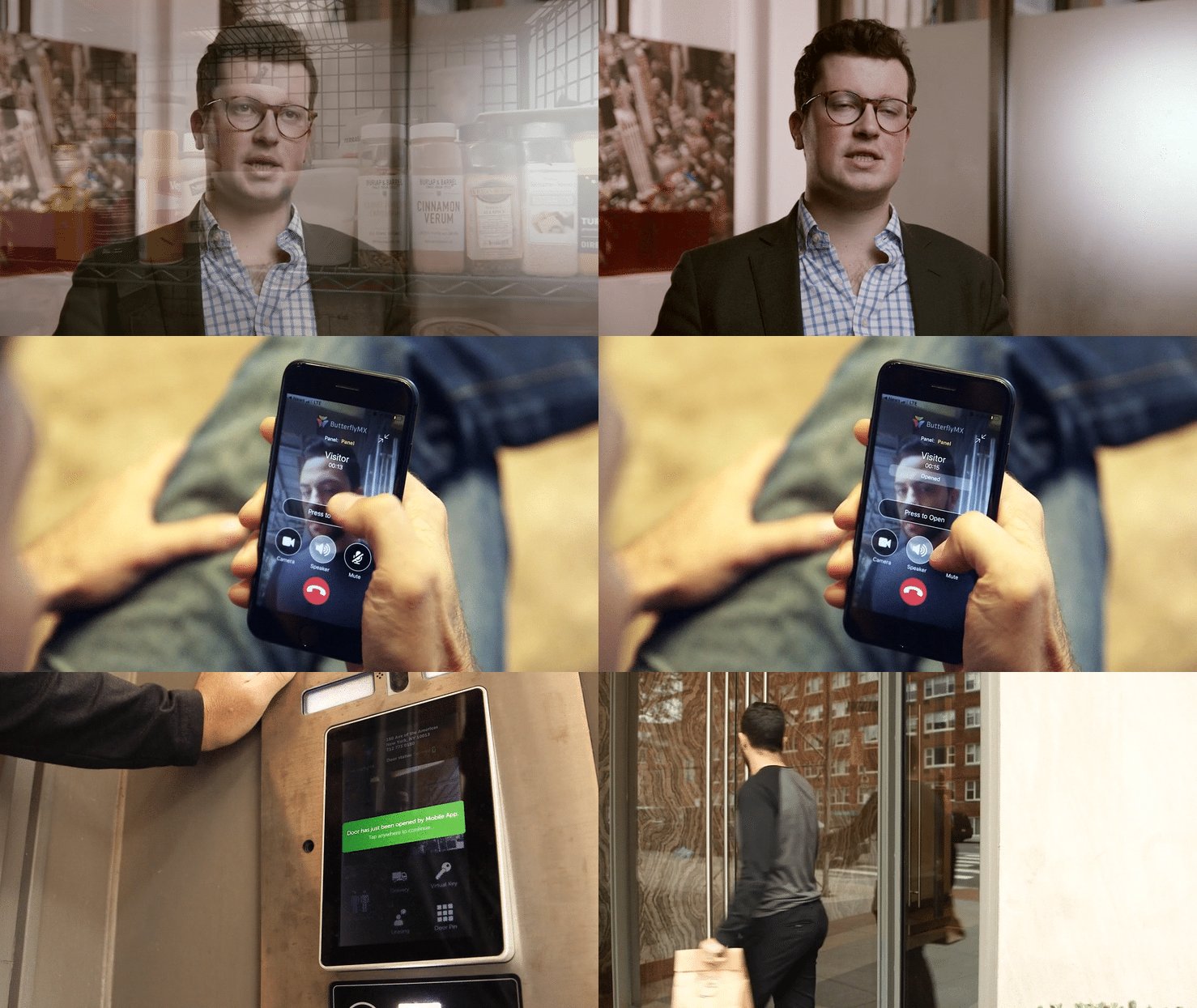
A strong testimonial doesn't just list or show product features; it delves into the real experiences of people we see on-screen talking about how they were affected by something. The example video below is a testimonial we produced for a digital, fully-integrated intercom system. Instead of simply showcasing the technology, we focused on an individual with first-hand knowledge of the product, and whose daily routine was genuinely transformed and, most importantly, streamlined.
The interviewee shared the challenges he was dealing with before the system was installed in his business, walked us through his personal experiences with the product and the team that installed it, and ultimately highlighted how the intercom system provided a very clear, real, and simple solution for his pain points. Viewers learn how it positively impacted his work; saving time, money, and preventing misunderstandings. This isn't just about a product - it's about a real person's journey from a pain point to a significant improvement.
Of course, we still included essential B-roll footage showing the product in action – those images are vital. But the heart of the video was undeniably the story. (And here's a pro tip: notice how the recommendation and product description were strategically placed at the very beginning of the video for immediate impact!)

Beyond the Product: Telling Personal Stories that Resonate
Sometimes, a testimonial needs to tap into deeply personal experiences to truly connect with an audience. This is most true when dealing with brands who provide personal services. Consider the legal world, where individuals facing personal tragedy need to feel they're not alone, and that help is available to them.
For one of our law firm clients, we filmed a testimonial where the client candidly shared how his life became incredibly difficult after an accident and how he felt lost and unsure where to turn. This powerful narrative allows potential clients to see their own struggles reflected, offering a sense of understanding and hope. To maximize the emotional impact, this kind of testimonial often begins with the pivotal moment when everything changed forever.

Ready to Create Your Own Impactful Testimonial Video? Your First Steps:
While no two testimonial videos are exactly alike, there are some fundamental rules that can guide you toward success:
Start Early with Buy-In: Securing permission and scheduling time with external clients or individuals can be challenging. Plan well in advance to get them on board.
Seek First-Hand Knowledge: The most authentic testimonials come from those who have direct, personal experience with your product or service. This personal touch is invaluable.
Encourage Sincerity (No Coaching!): The goal is genuine emotion and heartfelt responses. Provide interviewees with the questions in advance so they can gather their thoughts, but avoid rehearsing or memorizing answers. We want their true voice to shine through.
Ask the Right Questions: Before filming, determine the key messages you want to convey about your product or service. Then, craft questions designed to elicit answers that naturally incorporate those messages.
Don't Forget B-Roll: This supplementary footage adds context, visual interest, and helps bring the interview to life. You can see examples of effective B-roll in the videos mentioned above.
Choose Your Speakers Wisely: Select individuals who can articulate their experiences clearly and compellingly.
What kind of story do you want to tell with your next testimonial video? What is going to make it a great testimonial video? Can the answer really boil down to just one word? We think so. Tell your story with the help of your clients to really show that your brand is worth getting to know.
What to Expect on Your Video Shoot: A Client's Guide to the Production Team
Demystify your video shoot! Learn what to expect on set and meet the key professionals—from Producers to Directors—who bring your brand's vision to life, ensuring a smooth and successful video production experience.

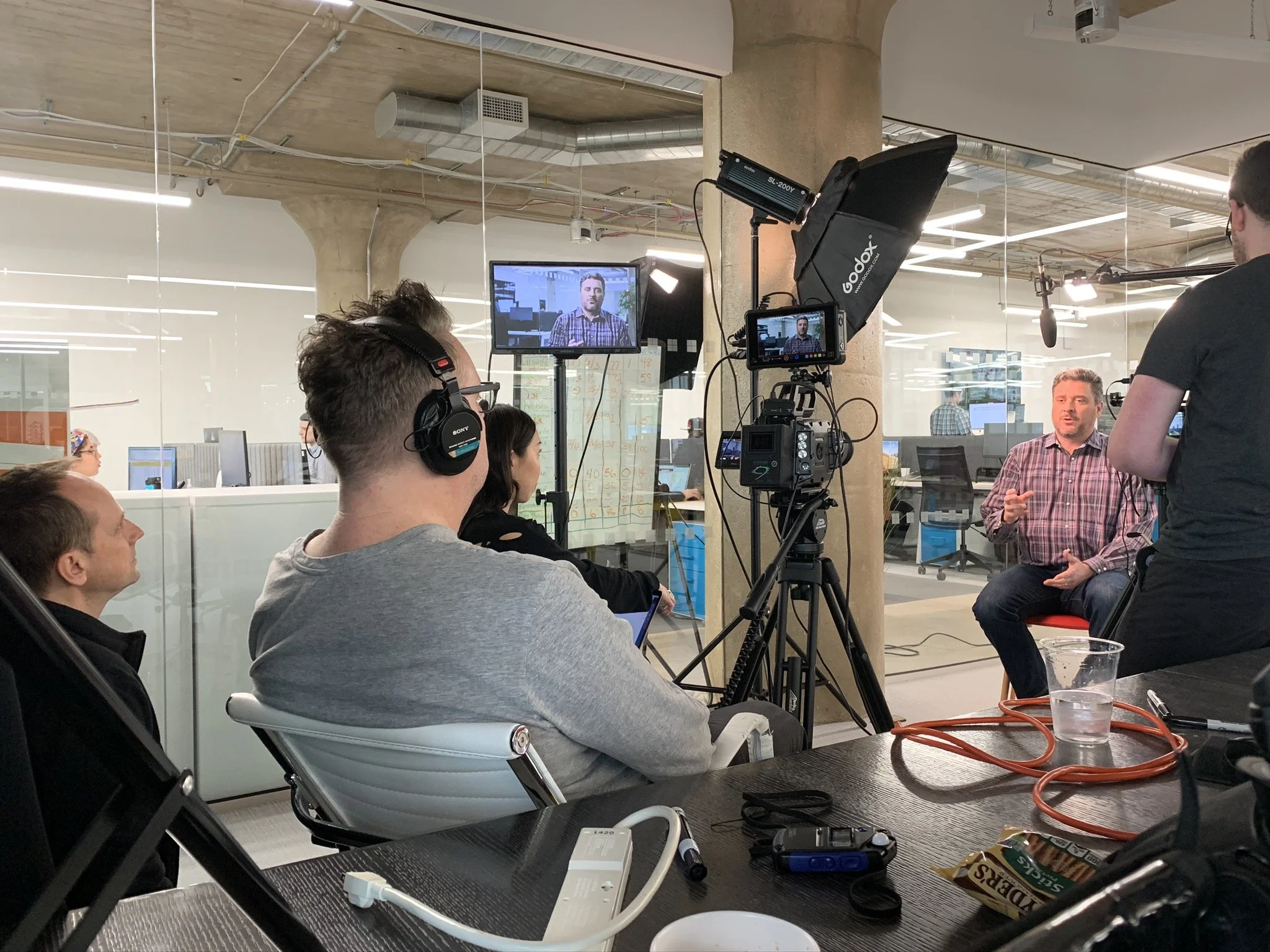
In this picture; Director, Director of Photography, 1st Assistant Camera, Grip, Production Assistants, Boom Op.
Getting started on a video project for your brand can be an exciting journey, and as the big day gets closer you may find yourself asking, "what is going to happen during the shoot?" or "who are all these people, and what do they do?" We're here to demystify the process and introduce you to the key professionals who will bring your vision to life.
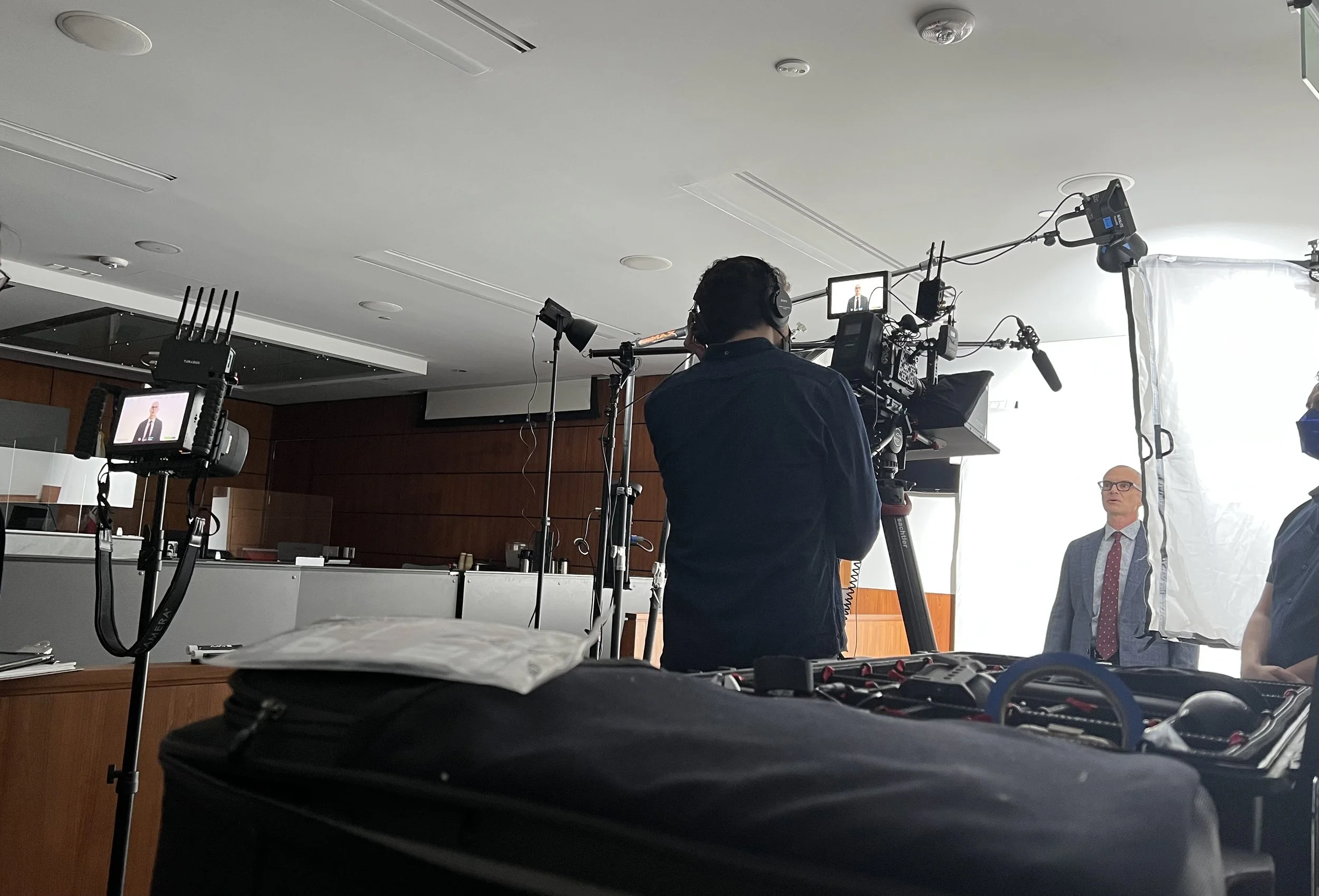
Some projects are really big and require really big teams. Other projects are quick and easy and only require three to four people to get it done. And some projects require locations, props, production design, transportation and logistics, and hired talent while others require a simple room, a couple of lights, a camera and microphone.
Sometimes each member of a production team has just one thing they do, while other projects require team members to do multiple things. If you’ve ever seen a movie being shot and wondered why there are a hundred people working on it, it’s because there are so many moving parts to keep an eye on.
The team that works on your project is going to be determined by its complexity and its scale. So let’s dive into some of the team members you may meet.
Here Are Some People and Roles You May Meet Along the Way
Producer
The Producer, in feature film speak, is the person or company who is funding the production. In the case your brand’s project, you are the producer.
Director
The Director is the production’s “CEO”. They are the most visible on the shoot day and they are very involved in the details. They watch all parts of the production and answer any questions or concerns as they arise. For your project, they make sure that spoken lines are delivered correctly, the look-and-feel of the images coming into the camera look they way they’re supposed to, they act as liaison with your team, and most importantly they make sure your brand and product look amazing.
Assistant Director (AD)
Your production could have multiple Assistant Directors depending on its size. They report to the Director. They’ll manage the set schedule, shot list, props and assure everything is staying on script.
Scriptwriter/Screenwriter
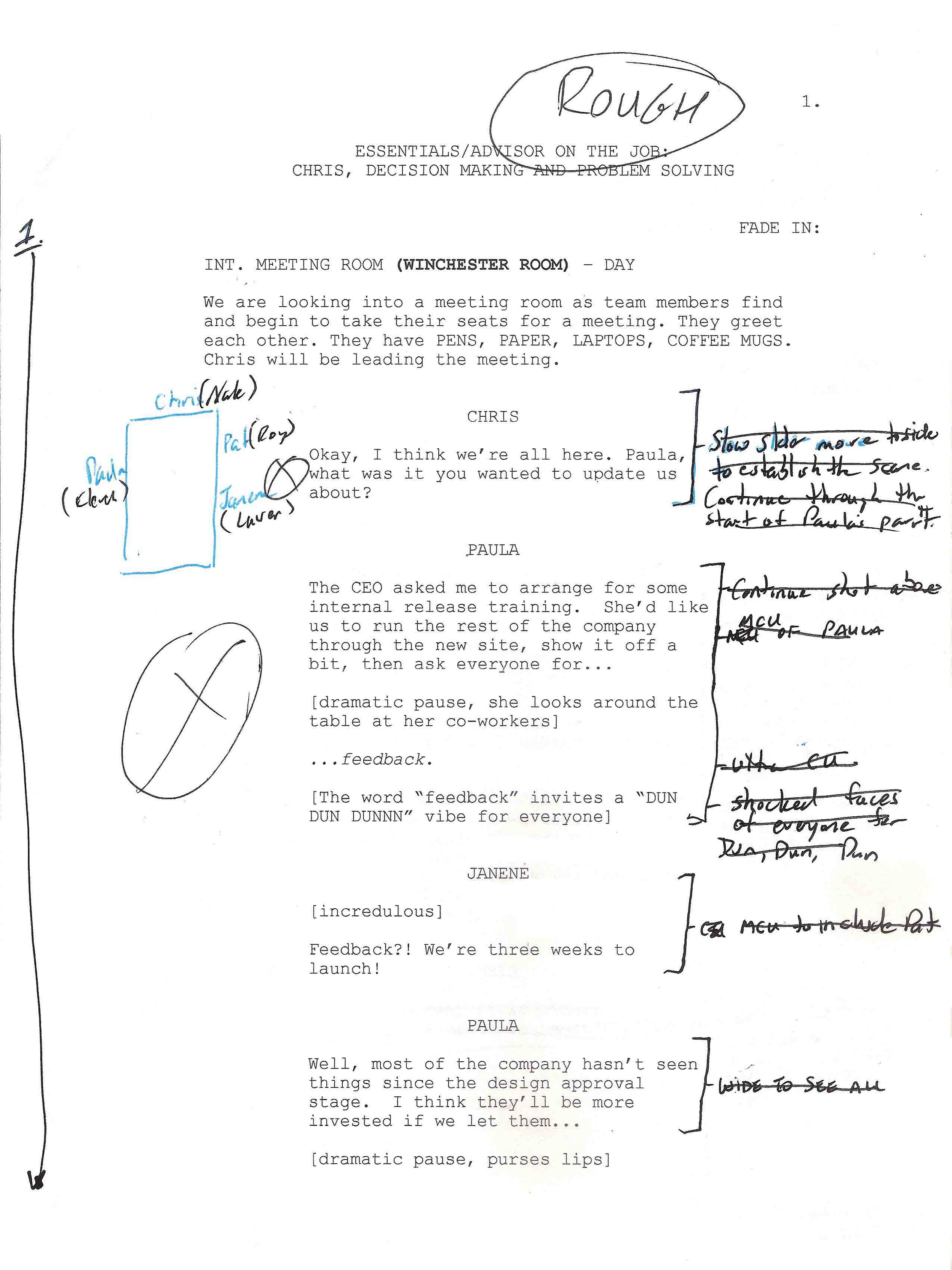
Here’s a script with notes from the Scriptwriter, Director, DP. Looks like a mess?
This one is pretty self-explanatory, but the Scriptwriter writes and edits the script. They work to advance the story, align with the strategy and reach the desired goals for the production.
Director of Photography/Cinematographer (DP)
The Director of Photographer, or Cinematographer, is the person who brings the script to life on film. They are responsible for planning and executing the use of lighting, camera angles, colors of lights, cameras and other equipment to ensure the right mood and look is on target. They work very closely with the Director to ensure the Director’s vision is accomplished.
Camera Operator
This role reports to the DP and operators the camera and associated gear according to the DP’s direction. It includes ensuring the color, lighting, focus, exposures, and other filming aspects are adjusted accordingly. They may also have an assistant to help with cables, batteries and other duties.
Lighting Director / Gaffer
The lighting director and or gaffer work together to manage the lights and all associated components and plans. The gaffer is the electrician, while the lighting director makes decisions to achieve the right look and light placement.
Key Grip
The key grip secures lighting, cameras, microphones and anything on the set that needs to be rigged in a specific place.
Audio Technician or Audio Engineer
The audio tech manages audio recording, microphones, and monitors and adjusts audio levels. They place microphones on the people who will be on camera, and they are magicians at hiding microphones in clothing, props and just about anywhere else they need to in order to get great sound without being obvious.

Set Designers help plan and execute everything on set that needs to be seen in a shot. They work as part of the Art Department.
Production Designer
The production designer understands the way a scene should look. And they use paint, props, wardrobe and more to make sure what you see on camera looks right. For example, if your brand colors are blue and orange, they’re going to make sure that the walls, clothing, etc. complement those colors. The work of a good production designer is the difference between a video shoot and a cinematic shoot.
Hair and Makeup (HMU)
HMU artists are the unsung heroes of film making. They make us all look good by making the talent look good. There’s an art to making sure people look good on camera and HMU knows how to bring the best out of skin complexions and hair colors.
Editor
The editor organizes and manages the filmed footage for the production and places them individually in the correct position to develop the sequence of scenes. It might seem confusing (see below) but a good editor knows the ins and outs of their editing program to make the most of the footage.
Here’s the editor’s view once the editing begins.
Production Assistant
Last, but certainly not least, the production assistants help do a bunch of little things to save other staff time and keep the production running smoothly. This could include getting lunch, organizing equipment, standing in for an actor, keeping an eye on equipment that isn’t being used (this is sometimes referred to as Fire Watching), or any number of small tasks.
Each of these roles requires a specific skill set that will help make a video project better and more cost effective in the long run.